Certification C_S4CPB_2602 Cost, Training C_S4CPB_2602 Solutions
Wiki Article
What's more, part of that Free4Torrent C_S4CPB_2602 dumps now are free: https://drive.google.com/open?id=1-if2hGZibM0TnSxSNavLl-gBvYhLhJt9
Preparing with Free4Torrent SAP Certified - Implementation Consultant - SAP S/4HANA Cloud Public Edition (C_S4CPB_2602) (C_S4CPB_2602) practice exam would be the most effective way to get success. Free4Torrent would give you access to SAP Certified - Implementation Consultant - SAP S/4HANA Cloud Public Edition (C_S4CPB_2602) (C_S4CPB_2602) exam questions that are factual and unambiguous, as well as information that is important for the preparation of the C_S4CPB_2602 C_S4CPB_2602 exam.
The C_S4CPB_2602 PDF Questions of Free4Torrent are authentic and real. These SAP Certified - Implementation Consultant - SAP S/4HANA Cloud Public Edition (C_S4CPB_2602) (C_S4CPB_2602) exam questions help applicants prepare well prior to entering the actual SAP Certified - Implementation Consultant - SAP S/4HANA Cloud Public Edition (C_S4CPB_2602) (C_S4CPB_2602) exam center. Due to our actual C_S4CPB_2602 Exam Dumps, our valued customers always pass their SAP C_S4CPB_2602 exam on the very first try hence, saving their precious time and money too.
>> Certification C_S4CPB_2602 Cost <<
Training C_S4CPB_2602 Solutions - Reliable C_S4CPB_2602 Exam Voucher
Therefore, it is indispensable to choose a trusted website for real C_S4CPB_2602 dumps. Free4Torrent is one of the most reliable platforms to get actual C_S4CPB_2602 dumps. It offers the latest and valid real SAP Certified - Implementation Consultant - SAP S/4HANA Cloud Public Edition (C_S4CPB_2602) (C_S4CPB_2602) exam dumps. The product of Free4Torrent is available in SAP C_S4CPB_2602 PDF, desktop C_S4CPB_2602 practice exam software, and web-based SAP Certified - Implementation Consultant - SAP S/4HANA Cloud Public Edition (C_S4CPB_2602) practice test.
SAP Certified - Implementation Consultant - SAP S/4HANA Cloud Public Edition (C_S4CPB_2602) Sample Questions (Q15-Q20):
NEW QUESTION # 15
SIMULATION
Note: In this practical certification exam, you will only be given high-level instructions. The step descriptions are complete and tested to work. They are not detailed, as this is a test of your knowledge of navigating the system on your own.
Caution: Please make sure you are always using your assigned group number. The last 6 digits are denoted as ###### in the following tasks. Your results will not be recorded if you are not using your own group number. To find your group number: Select your user in the top right corner. You will see your user name with a series of numbers. Use the last 6 digits as your group number Caution: To keep the system running smoothly and avoid unnecessary costs, please follow the assigned exercises carefully when using the SAP Landscape. Avoid going beyond the exercise scope and only use your group number to help maintain a stable and efficient environment for everyone.
Answer:
Explanation:
See Explanation below for all solution
Explanation:
Purpose: Identify your own six-digit suffix and use it consistently in every task.
Open the user menu at the top-right of SAP S/4HANA Cloud.
Read your user name and note the last six digits.
Use those last six digits in every place the task PDF shows ######.
Example used in this guide: 000013
NEW QUESTION # 16
SIMULATION
Create a Custom Business Role with Restrictions
Business Scenario:
You are building a custom business role with restrictions to ensure the end users assigned the role have only the minimum level of access necessary to complete their core job tasks. The end users are project managers based in the United States. They should only be able to create projects, edit projects, and access projects that are occurring in the United States. They should not be able to staff any resources outside of the United States. Write, Read, and Value Help access should be restricted to only the United States for all relevant fields.
Prerequisites:
Note: In the task below, always replace ###### with the last 6 digits of your group number.
Note: Make sure to use the EXACT names/values/spaces as they are listed in the task. Even forgetting a space or a number will cause the validation of the task to fail and be marked as incorrect.
Task:
Restrict the fields listed below for the US / 1710. All other fields should be marked as Not Maintained. Save the role when finished.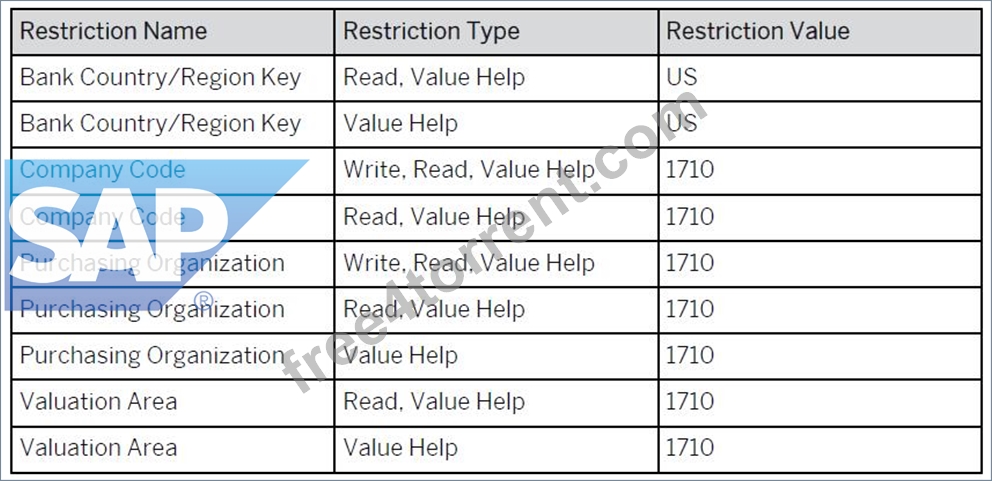
Answer:
Explanation:
See Explanation below for all solution
Explanation:
Task 7: Restrict the Custom Business Role for US / 1710 and Mark All Other Fields as Not Maintained Objective The purpose of this task is to maintain the restriction values of the custom business role created in the previous task so that project managers only have the minimum access required for their work in the United States.
This task is performed on the custom business role created from the template:
Template Role: SAP_BR_PROJECT_MANAGER_PROF
Custom Role Example Pattern: BR_PROJECT_MANAGER_PROF_US_######
The task requires you to:
maintain only the listed restriction fields,
enter the exact required values for US and 1710,
set all other restriction fields to Not Maintained,
and save the role.
Business Scenario Explanation
This restriction setup is what makes the new custom role safe and fit for purpose.
The business requirement says that end users:
are project managers based in the United States,
should only access relevant US project data,
should not be able to staff or work outside the intended scope,
should only see and maintain data for the allowed organizational scope.
This is achieved by limiting the role to:
US for country-related fields
1710 for company / organizational fields
Everything else must be Not Maintained so that unnecessary access is not left open.
Important Notes
Replace ###### with the last 6 digits of your group number.
Use the values exactly as shown.
Maintain only the fields listed in the table.
Set all other restriction fields to Not Maintained.
Do not leave unrelated fields blank while still restricted.
Restricted + blank is usually wrong.
Not Maintained is the correct setting for all unrelated fields.
Required Restriction Values
Use the following values exactly as shown in your task screenshot.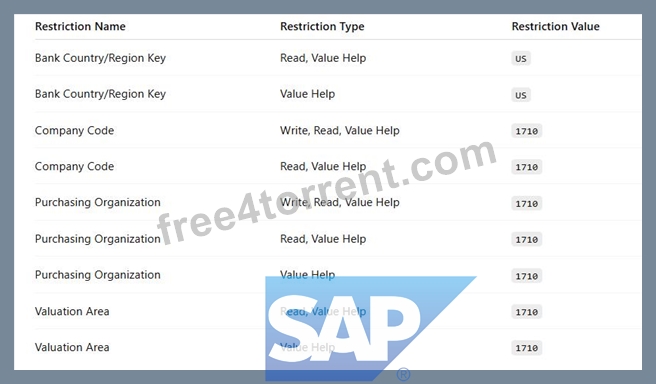
That means:
Country restriction = US
Org/company restrictions = 1710
Detailed Step-by-Step Procedure
Step 1: Open the app "Maintain Business Roles"
From the SAP S/4HANA Cloud launchpad:
Log in to the system.
Search for:
Maintain Business Roles
Open the app.
Explanation:
This app is where the custom role was created in the previous task and where its restrictions are maintained.
Step 2: Open your custom Project Manager US role
In Maintain Business Roles:
Search for your custom role.
Open the role with ID pattern:
BR_PROJECT_MANAGER_PROF_US_######
Example
If the suffix is 000457, then the role is:
BR_PROJECT_MANAGER_PROF_US_000457
Explanation:
You must open the custom role, not the standard SAP template role.
The restrictions belong to the derived custom role only.
Step 3: Confirm the correct custom role is open
Check the role details and confirm:
the business role ID matches your custom role,
the description matches the US-specific project manager role,
the role is based on template SAP_BR_PROJECT_MANAGER_PROF.
Explanation:
This avoids accidentally changing the wrong role.
Step 4: Click "Maintain Restrictions"
On the custom role page:
Click:
Maintain Restrictions
Explanation:
This opens the detailed restriction maintenance area where access categories and field-level values are controlled.
Step 5: Set the access categories for restriction maintenance
On the restriction page, ensure the access categories are maintained as required for the role.
During your run, these categories were maintained as restricted so values could be entered for the listed fields.
Explanation:
Restriction values can only be maintained correctly when the role is in the right restriction mode.
This step prepares the role so the listed fields can be populated with US / 1710 values.
Step 6: Understand the rule before entering values
This task uses a strict rule:
Keep maintained
Only the fields explicitly listed in the table should be maintained with values.
Set to Not Maintained
Every other restriction field not listed in the table must be marked:
Not Maintained
Explanation:
This is the most important logic in the whole task.
If a field is unrelated and still left as restricted or blank, it can cause validation problems or give more access than intended.
Part A: Maintain the required restriction fields
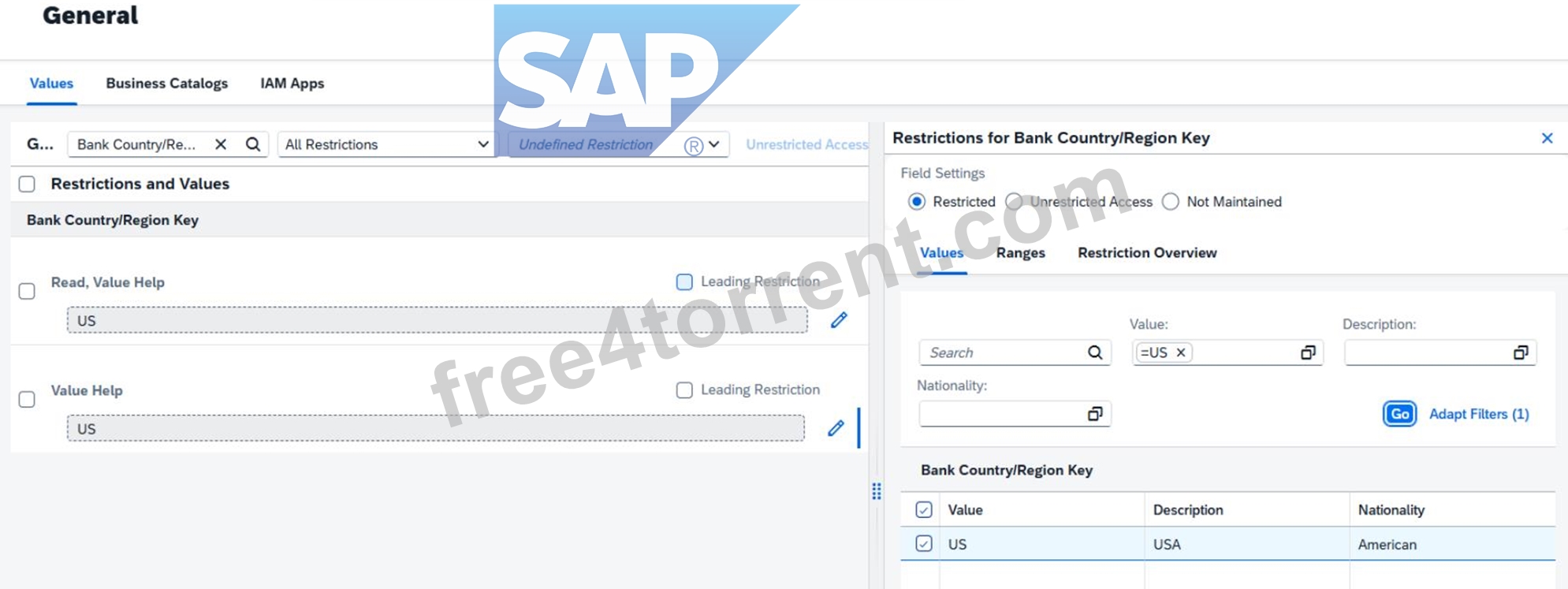
Step 7: Maintain Bank Country/Region Key
Search for:
Bank Country/Region Key
Then maintain:
Read, Value Help = US
Value Help = US
Explanation:
This ensures the user can only read and search bank-related values for the United States.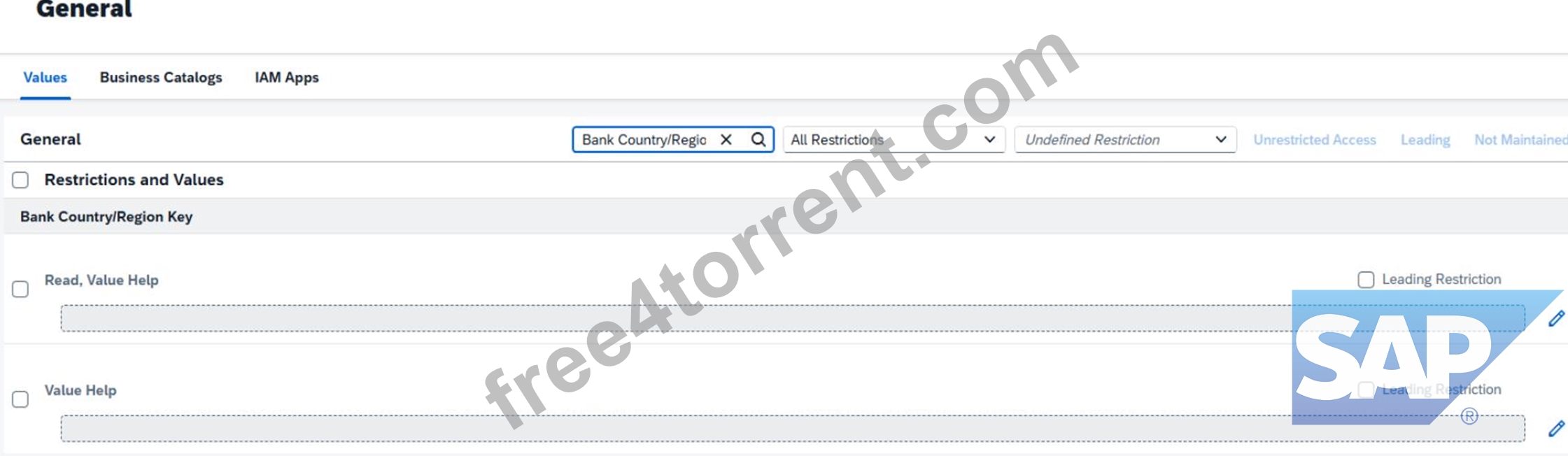
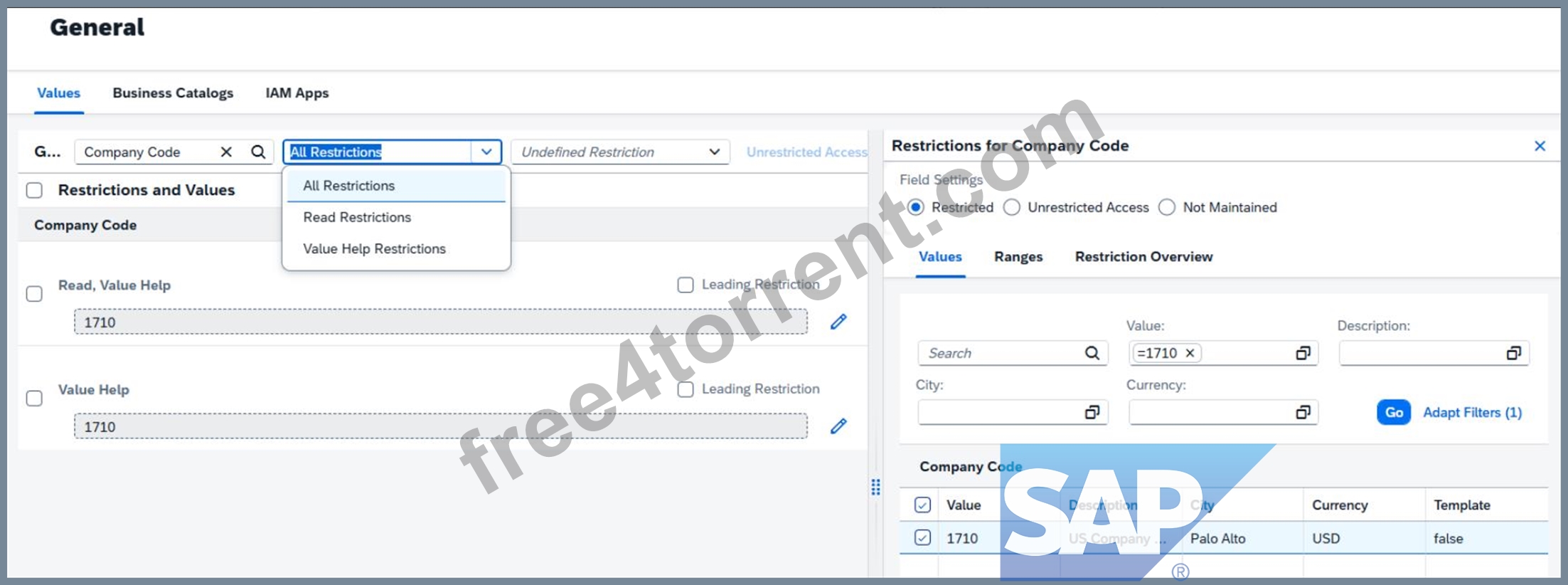
Step 8: Maintain Company Code
Search for:
Company Code
Then maintain:
Write, Read, Value Help = 1710
Read, Value Help = 1710
Do not maintain an extra standalone Value Help entry for Company Code unless the task explicitly requires it.
Explanation:
The task table does not include a standalone Company Code Value Help line.
So only the listed two Company Code restriction types should contain 1710.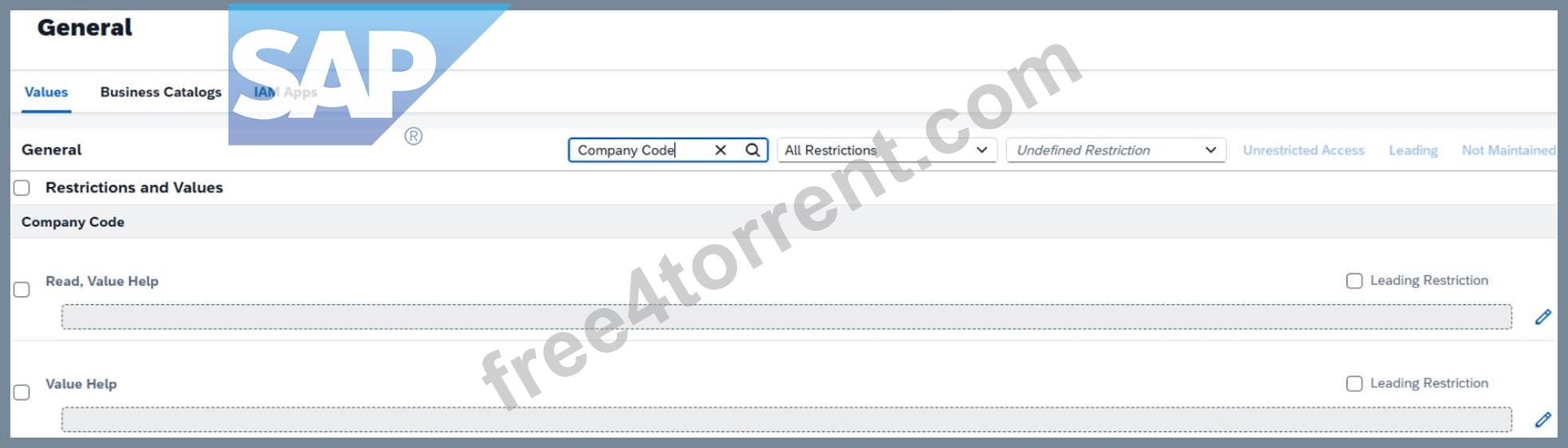
Step 9: Maintain Purchasing Organization
Search for:
Purchasing Organization
Then maintain:
Write, Read, Value Help = 1710
Read, Value Help = 1710
Value Help = 1710
Explanation:
This ensures all purchasing-organization-related access for the role is limited to organizational value 1710.
Step 10: Maintain Valuation Area
Search for:
Valuation Area
Then maintain:
Read, Value Help = 1710
Value Help = 1710
Explanation:
This limits valuation-related access to the intended organizational scope.
Part B: Set all other fields to Not Maintained
Step 11: Search through the other restriction fields
After entering the required fields, review the remaining restriction objects.
Examples from your run included fields such as:
Accounting Principle
Authorization Group for Business Partners
Billing Type
and many other unrelated restriction fields
Explanation:
These fields were not listed in the task table, so they must not stay restricted.
Step 12: Mark unrelated fields as Not Maintained
For each field not listed in the required table:
Open the field setting / restriction dialog.
Choose:
Not Maintained
Important examples
From your run:
Accounting Principle → Not Maintained
Authorization Group for Business Partners → Not Maintained
Billing Type → Not Maintained
Explanation:
These fields are outside the required US / 1710 restriction list.
If you leave them restricted without a required value, the setup is incorrect.
Step 13: Do not mark the listed fields as Not Maintained
The following must stay maintained with values because they are in the required table:
Bank Country/Region Key
Company Code
Purchasing Organization
Valuation Area
Explanation:
Only the unrelated fields become Not Maintained.
The listed fields must remain restricted with the required values.
Step 14: Save the role
After all required fields are maintained and all other fields are marked Not Maintained:
Click Save
Explanation:
This finalizes the role restrictions.
Without saving, the restriction changes remain incomplete.
Step 15: Verify the restriction result
After saving, verify that:
required fields contain US and 1710 exactly as defined,
unrelated fields are no longer restricted,
the role saves without error.
Explanation:
This is your final proof that the restricted custom role has been completed correctly.
Expected Result
After the task is completed successfully:
the custom role remains based on SAP_BR_PROJECT_MANAGER_PROF,
required US / 1710 restriction fields are maintained,
all unrelated restriction fields are marked Not Maintained,
the role is saved successfully,
the role now reflects minimum necessary access for US-based project managers.
NEW QUESTION # 17
SIMULATION
Migrate Bank Data
Business Scenario
You are responsible for migrating bank data into the SAP S/4HANA Cloud Public Edition system. You have determined the best method is Migrate Data Using Staging Tables, as you only have a couple banks to migrate.
Prerequisites:
Note:
In the task below, always replace ###### with the last 6 digits of your group number.
Note:
Make sure to use the EXACT names/values/spaces as they are listed in the task. Even forgetting a space or a number will cause the validation of the task to fail and be marked as incorrect.
Task:
Migrate the bank data listed below.
Table 1: Bank 1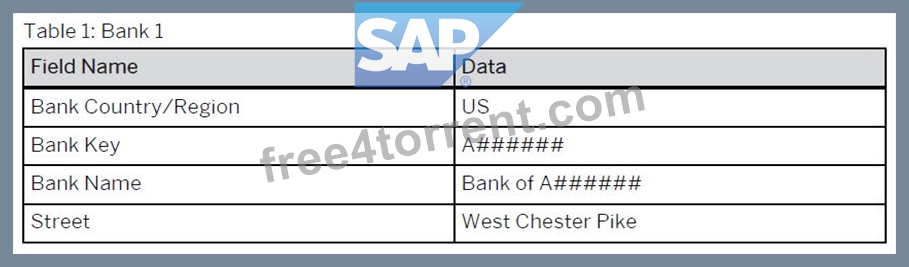
Answer:
Explanation:
See Explanation below for all solution
Explanation:
Objective
The purpose of this task is to migrate two bank master records into SAP S/4HANA Cloud Public Edition using the Migrate Data Using Staging Tables approach.
This task is performed inside the migration project created earlier:
Migration Project Name: Bank Data ######
Migration Object: Bank
The bank master data must be entered exactly as provided in the task tables.
Business Scenario Explanation
In this scenario, you are responsible for loading a small number of bank records into the system. Because there are only two banks to migrate, the selected migration method is:
Migrate Data Using Staging Tables
This method requires you to:
open the existing migration project,
download the Bank templates,
populate the required CSV file with the bank data,
upload the files,
validate the data,
transfer the data to staging tables,
complete any required mapping tasks,
migrate the bank instances,
verify the migrated banks in the target app.
Important Notes
Always replace ###### with the last 6 digits of your group number.
Use the values exactly as shown in the task.
Keep names, spaces, and numbers exactly correct.
During your execution, mappings may be required for:
Country/Region Key
Language Key (ISO)
Regional Code
Bank Key
If regional text values like Pennsylvania or Georgia are rejected, mapping may be needed to:
PA
GA
Example
If the suffix is 000013, the values become:
Bank 1
Bank Country/Region = US
Bank Key = A000013
Bank Name = Bank of A000013
Street = West Chester Pike
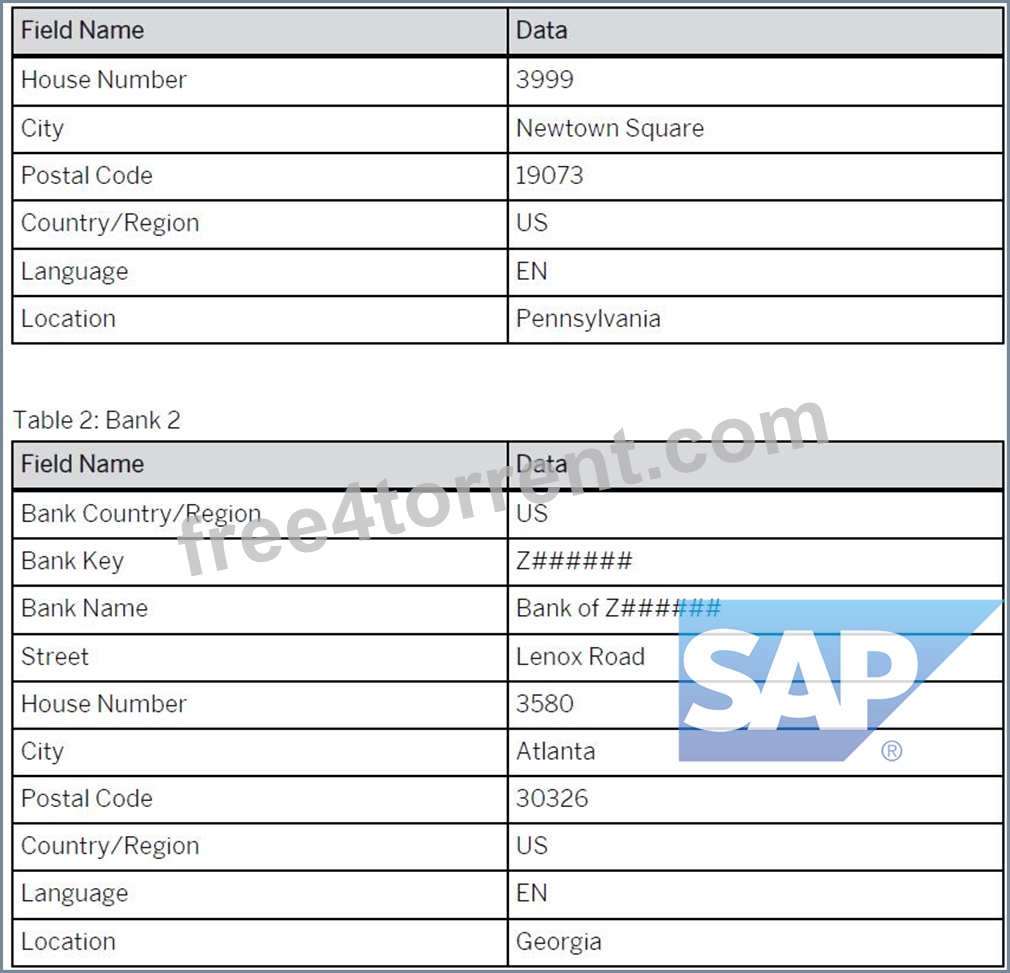
House Number = 3999
City = Newtown Square
Postal Code = 19073
Country/Region = US
Language = EN
Location = Pennsylvania
Bank 2
Bank Country/Region = US
Bank Key = Z000013
Bank Name = Bank of Z000013
Street = Lenox Road
House Number = 3580
City = Atlanta
Postal Code = 30326
Country/Region = US
Language = EN
Location = Georgia
Detailed Step-by-Step Procedure
Step 1: Open the app "Migrate Your Data"
From the SAP S/4HANA Cloud launchpad:
Log in to SAP S/4HANA Cloud.
Search for:
Migrate Your Data
or
Migration Projects
Open the app.
Explanation:
This app is the migration cockpit where the project and Bank migration object are maintained.
Step 2: Open the migration project
In the migration projects list:
Search for your project:
Bank Data ######
Open the project.
Example
If your suffix is 000013, open:
Bank Data 000013
Explanation:
This is the migration project created in the previous task and it contains the migration object Bank.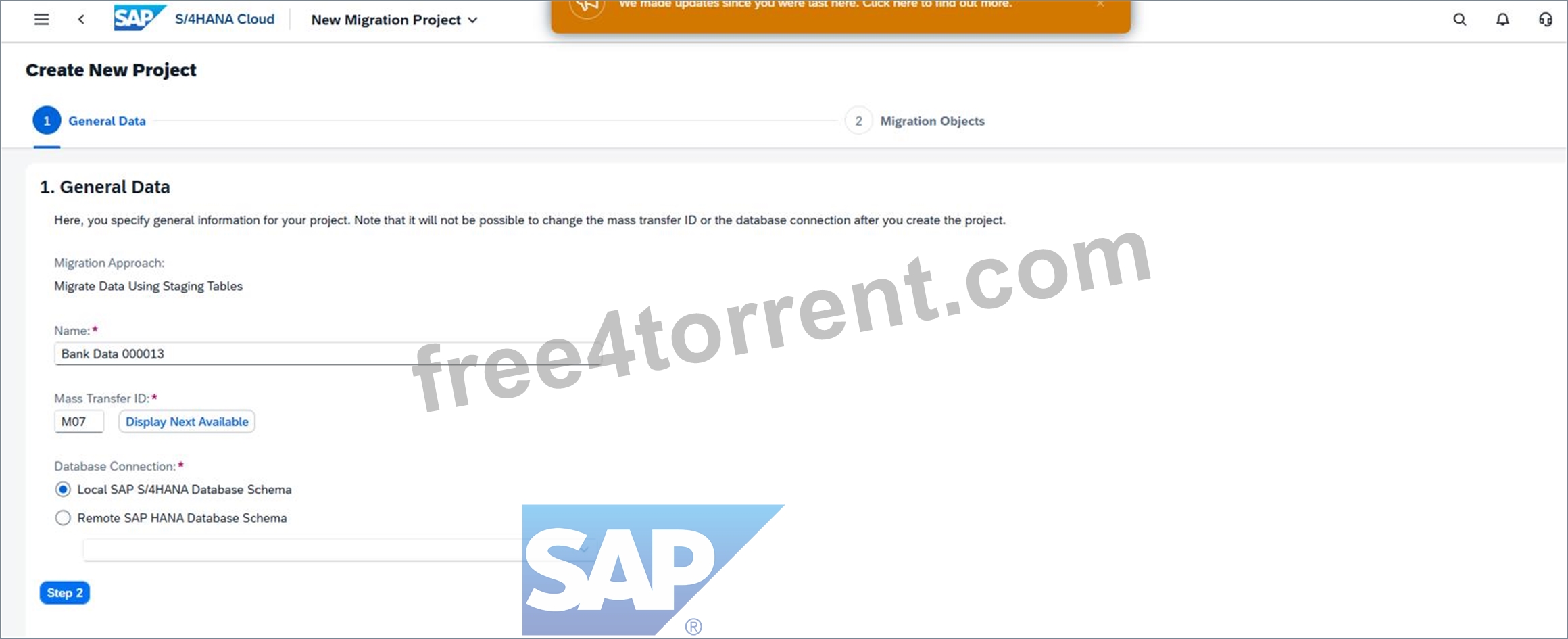
Step 3: Open the Bank migration object
Inside the migration project:
Locate the migration object:
Bank
Open it.
Explanation:
The Bank migration object is where the templates, uploads, mapping tasks, and migration instances are handled.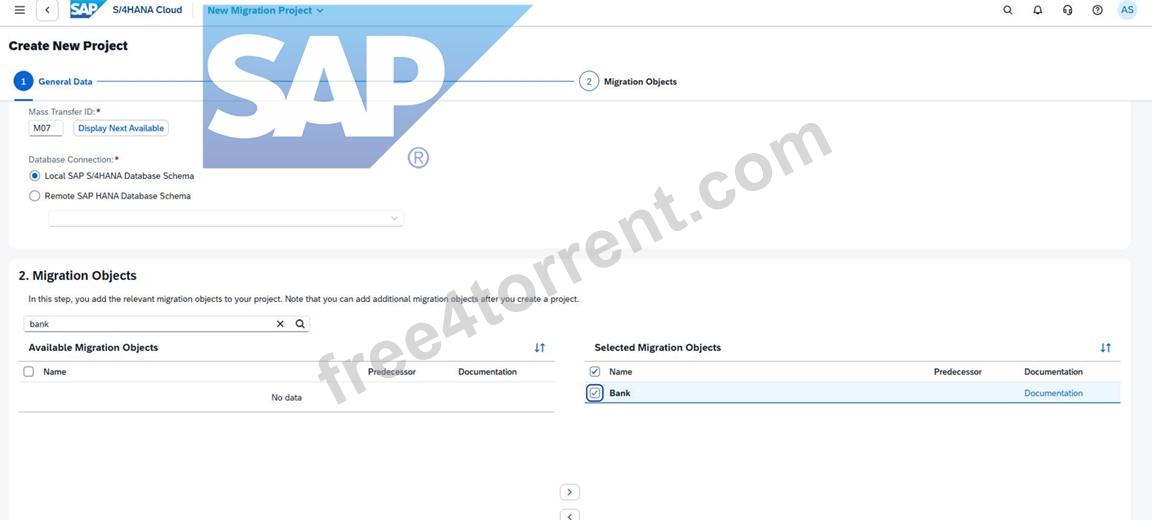
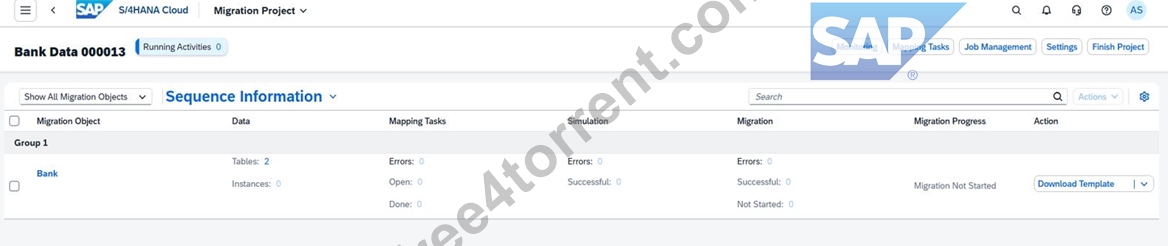
Step 4: Download the template files
On the Bank migration object screen:
Click:
Download Template
This provides the CSV template files needed for migration.
Explanation:
For the Bank migration object, the main files typically include:
S_BNKA#FreeText_Mandatory.csv
S_SCRIPT_ADRC#FreeText.csv
The mandatory file contains the bank master structure; the second file is optional for international address versions.
Step 5: Populate the mandatory Bank CSV file
Open the mandatory CSV file:
S_BNKA#FreeText_Mandatory.csv
Enter the two bank records exactly as required from the task tables.
Explanation:
This file must contain the bank master data that will be loaded into the staging tables.
The data must match the required values exactly.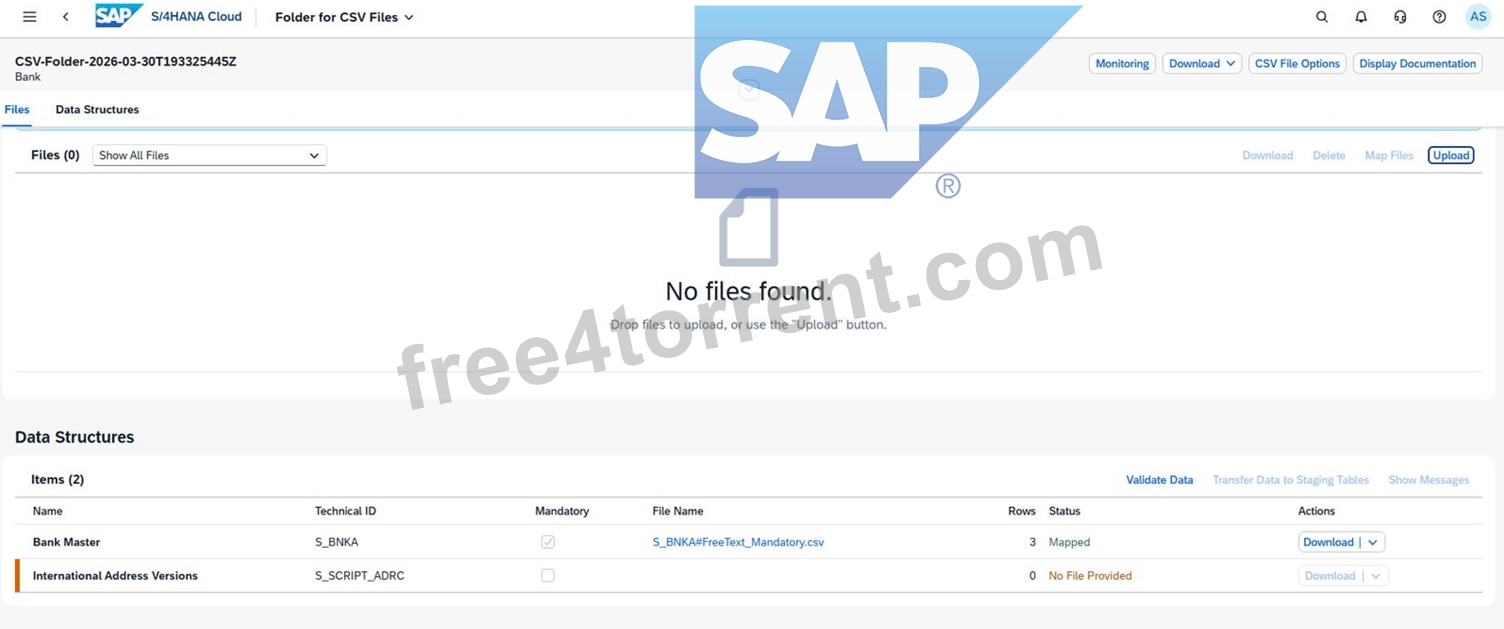
Step 6: Use the correct values in the Bank CSV
Populate the mandatory file with the two records.
Bank 1
Bank Country/Region = US
Bank Key = A######
Bank Name = Bank of A######
Street = West Chester Pike
House Number = 3999
City = Newtown Square
Postal Code = 19073
Country/Region = US
Language = EN
Location = Pennsylvania
Bank 2
Bank Country/Region = US
Bank Key = Z######
Bank Name = Bank of Z######
Street = Lenox Road
House Number = 3580
City = Atlanta
Postal Code = 30326
Country/Region = US
Language = EN
Location = Georgia
Explanation:
These values create two bank master records, one beginning with key A###### and the other with key Z######.
Step 7: Keep the optional international address file empty if not needed For the file:
S_SCRIPT_ADRC#FreeText.csv
leave it with header only if no separate international address version data is required.
Explanation:
During your execution, the optional file was not required and the Bank migration still proceeded because only the mandatory Bank Master structure had to be populated.
Step 8: Open Upload Files
In the Bank migration object:
Go to:
Upload Files
Explanation:
This is where the CSV folder is created and the files are uploaded to the migration cockpit.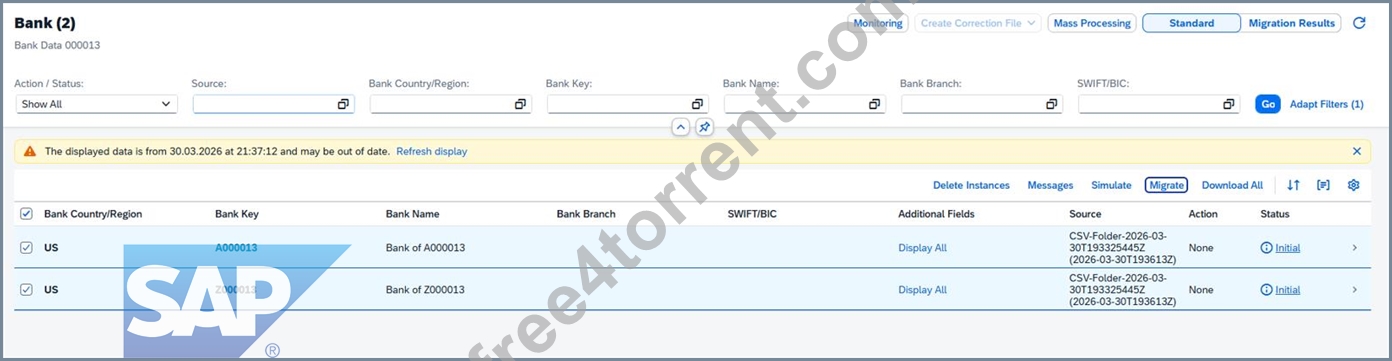
Step 9: Create a CSV Folder
Click:
Create CSV Folder
Explanation:
When using CSV with staging tables, SAP groups the upload into a CSV folder structure.
Step 10: Upload the CSV files
Upload:
S_BNKA#FreeText_Mandatory.csv
S_SCRIPT_ADRC#FreeText.csv (optional / empty if not used)
Explanation:
The mandatory file is required.
The optional file may remain empty or not provided depending on the migration object's structure.
Step 11: Validate the data
After upload:
Click:
Validate Data
Explanation:
This checks:
file readability,
required columns,
correct structure,
duplicate keys,
and data consistency.
Step 12: Correct any file or format errors if needed
During execution, common issues included:
wrong file mapping,
UTF-8 / CSV reading problems,
missing mandatory fields,
duplicate key values,
region value mismatches.
Explanation:
You must resolve validation errors before continuing to staging tables.
Examples from your run:
duplicate key values had to be corrected,
file structure mapping had to be adjusted,
CSV encoding had to be corrected.
Step 13: Transfer data to staging tables
After validation is successful, click:
Transfer Data to Staging Tables
Explanation:
This moves the validated CSV data into SAP's staging tables so the Bank migration object can create migration instances.
Step 14: Go to Mapping Tasks if required
If the system shows mapping tasks, open:
Mapping Tasks
Explanation:
For your run, the following mappings had to be confirmed:
Country/Region Key
Language Key (ISO)
Regional Code
Bank Key
Step 15: Maintain mapping values
If mappings appear, confirm or maintain them as follows:
Country/Region Key
source US → target US
Language Key (ISO)
source EN → target EN
Regional Code
If text values are shown:
source Pennsylvania → target PA
source Georgia → target GA
Bank Key
Confirm the system-generated source values to the correct target values for:
A######
Z######
Explanation:
These mappings are required when the migration object needs target-system value confirmation before posting the records.
Step 16: Confirm the mapping tasks
After maintaining the mappings:
Click:
Confirm
Explanation:
All mapping task statuses should change to Confirmed before running migration again.
Step 17: Open the Bank instances
Return to the Bank migration object and open:
Instances
Explanation:
This screen shows the individual bank records created from the staging-table data.
Step 18: Select the bank instances
Select both bank records.
Expected rows:
US / A######
US / Z######
Explanation:
Both bank records must be selected so they can be migrated into the target system.
Step 19: Click Migrate
Click:
Migrate
Explanation:
This starts the actual creation of bank master records in the target SAP S/4HANA Cloud system.
Step 20: Resolve authorization issue if it appears
During your execution, migration initially failed with:
You are not authorized to create bank data for country/region US
The fix was to assign the additional business role:
Master Data Specialist - Bank Data
SAP_BR_MD_SPECIALIST_BNK
Explanation:
The migration cockpit role alone is not always enough.
Bank creation also requires bank master data authorization.
Step 21: Refresh and check migration status
After migration:
Refresh the screen.
Check the status of both bank instances.
Expected final result:
Success
Success
Explanation:
Both bank rows must finish successfully for the task to be considered complete.
Step 22: Verify in "Manage Banks - Master Data"
Open:
Manage Banks - Master Data
Search for:
US / A######
US / Z######
Explanation:
This is the final business verification step that proves the bank master records were created successfully in the system.
Expected Result
After this task is completed successfully:
both bank records are loaded through staging tables,
all mapping tasks are confirmed,
both migration instances complete successfully,
the two banks are visible in Manage Banks - Master Data.
NEW QUESTION # 18
SIMULATION
Migrate Bank Data
Business Scenario
You are responsible for migrating bank data into the SAP S/4HANA Cloud Public Edition system. You have determined the best method is Migrate Data Using Staging Tables, as you only have a couple banks to migrate.
Prerequisites:
Note:
In the task below, always replace ###### with the last 6 digits of your group number.
Note:
Make sure to use the EXACT names/values/spaces as they are listed in the task. Even forgetting a space or a number will cause the validation of the task to fail and be marked as incorrect.
Task:
Use the correct app to verify your data has been migrated successfully (see the documentation for the Bank migration object).
Answer:
Explanation:
See Explanation below for all solution
Explanation:
Objective
The purpose of this task is to use the correct SAP app to verify that the bank master data migrated in the previous task was created successfully in the target system.
The correct verification app is:
Manage Banks - Master Data
SAP's documentation for bank maintenance assigns this app to the bank master data role and uses it for maintaining and checking bank records, which matches the verification step after migration.
Business Scenario Explanation
In the previous migration tasks, you:
created the migration project,
selected the Bank migration object,
prepared and uploaded the bank data,
validated and transferred it to staging tables,
completed mapping tasks,
migrated the two bank records.
However, a migration is not considered complete until the data is verified in the target application used for ongoing business maintenance.
For the Bank migration object, that target verification app is:
Manage Banks - Master Data
This app allows you to search for the migrated banks and confirm that the data now exists in SAP S/4HANA Cloud Public Edition.
Important Notes
Always replace ###### with the last 6 digits of your group number.
Use the exact bank values that were migrated.
Verification must be done in the correct app, not only in the migration cockpit.
The expected bank records are the two banks from the previous task.
Correct Verification App
Purpose
App
Verify migrated bank master data
Manage Banks - Master Data
SAP documents that bank master maintenance is handled through the bank master data application and the associated bank maintenance role/catalog, which is why this is the correct end-user verification app after bank migration.
Data to Verify
You should verify the two migrated banks:
Bank 1
Bank Country/Region = US
Bank Key = A######
Bank Name = Bank of A######
Bank 2
Bank Country/Region = US
Bank Key = Z######
Bank Name = Bank of Z######
Example
If your suffix is 000013, verify:
US / A000013 / Bank of A000013
US / Z000013 / Bank of Z000013
Detailed Step-by-Step Procedure
Step 1: Return to the SAP Fiori launchpad
After finishing the migration:
Go back to the SAP S/4HANA Cloud homepage.
Explanation:
The verification must be performed in the target business app, not only from the migration results screen.
Step 2: Open the app "Manage Banks - Master Data"
From the launchpad search:
Search for:
Manage Banks - Master Data
Open the app.
Explanation:
This is the correct app for checking whether the migrated bank master records now exist in the target system.
Step 3: Search for the first migrated bank
In Manage Banks - Master Data:
In Bank Country/Region, enter:
US
In Bank Key, enter:
A######
Click Go
Example
If your suffix is 000013, search for:
Bank Country/Region = US
Bank Key = A000013
Explanation:
This checks whether the first migrated bank was created successfully.
Step 4: Verify the first bank details
Confirm that the search result shows the correct bank record:
Bank Country/Region = US
Bank Key = A######
Bank Name = Bank of A######
You can also verify address data if visible, such as:
Street = West Chester Pike
City = Newtown Square
Explanation:
This confirms that the first bank master record exists in the target system after migration.
Step 5: Search for the second migrated bank
Clear or update the search criteria and enter:
Bank Country/Region = US
Bank Key = Z######
Click Go
Example
If your suffix is 000013, search for:
Bank Country/Region = US
Bank Key = Z000013
Explanation:
This checks whether the second migrated bank was created successfully.
Step 6: Verify the second bank details
Confirm that the second search result shows:
Bank Country/Region = US
Bank Key = Z######
Bank Name = Bank of Z######
You can also verify address data if visible, such as:
Street = Lenox Road
City = Atlanta
Explanation:
This confirms that the second bank master record exists in the target system after migration.
Step 7: Confirm successful verification
If both banks are visible in Manage Banks - Master Data, the migration verification is successful.
Explanation:
This is the final proof that the migration did not only complete technically in the cockpit, but also posted the expected business data into the target application.
Expected Result
After this task is completed successfully:
the app Manage Banks - Master Data is used for verification,
Bank 1 is visible:
US / A###### / Bank of A######
Bank 2 is visible:
US / Z###### / Bank of Z######
the migrated bank data is confirmed as successfully created in the target system.
NEW QUESTION # 19
SIMULATION
Migrate Bank Data
Business Scenario
You are responsible for migrating bank data into the SAP S/4HANA Cloud Public Edition system. You have determined the best method is Migrate Data Using Staging Tables, as you only have a couple banks to migrate.
Prerequisites:
Note:
In the task below, always replace ###### with the last 6 digits of your group number.
Note:
Make sure to use the EXACT names/values/spaces as they are listed in the task. Even forgetting a space or a number will cause the validation of the task to fail and be marked as incorrect.
Task:
Create a new migration project with the information listed below.
Answer:
Explanation:
See Explanation below for all solution
Explanation:
Objective
The purpose of this task is to create a new migration project for the bank data migration scenario in SAP S/4HANA Cloud Public Edition.
The migration method for this scenario is:
Migrate Data Using Staging Tables
The migration project must be created with the exact values provided in the task.
Business Scenario Explanation
In this scenario, you are responsible for migrating bank master data into SAP S/4HANA Cloud Public Edition.
Because only a few banks need to be loaded, the selected migration approach is:
Migrate Data Using Staging Tables
Before any files can be uploaded or any bank data can be validated and migrated, a migration project must first be created. This project acts as the main container for:
the migration object,
the staging-table upload,
validation,
mapping,
transfer to staging tables,
and the final migration execution.
Important Notes
Always replace ###### with the last 6 digits of your group number.
Use the exact values shown in the task.
The migration project must be created using:
Migrate Data Using Staging Tables
The migration object must be:
Bank
Save or create the project only after confirming the values are correct.
Required Values
Use the following values exactly as shown in the task image.
Parameter
Data
Name
Bank Data ######
Migration object
Bank
Example
If your suffix is 000013, then the values become:
Name = Bank Data 000013
Migration object = Bank
Detailed Step-by-Step Procedure
Step 1: Open the app "Migrate Your Data"
From the SAP S/4HANA Cloud launchpad:
Log in to SAP S/4HANA Cloud.
Use the app search.
Search for:
Migrate Your Data
or
Migration Projects
Open the app.
Explanation:
This app is the migration cockpit used to create migration projects and load master data and transactional data into the system.
Because the task asks you to create a new migration project, this is the correct starting point.
Step 2: Start creating a new migration project
Inside the migration app:
Click:
Create
When the dropdown appears, select:
Migrate Data Using Staging Tables
Explanation:
This is very important because the business scenario explicitly says that the chosen migration method is Migrate Data Using Staging Tables.
Do not choose:
Migrate Data Directly from SAP System
That would be the wrong migration approach for this task.
Step 3: Enter the migration project name
In the project creation screen, enter:
Name = Bank Data ######
Example
If your suffix is 000013, enter:
Bank Data 000013
Explanation:
This is the name of the migration project and must exactly match the task requirement.
Step 4: Keep the staging-table migration approach
On the project creation screen, confirm the migration approach is:
Migrate Data Using Staging Tables
Explanation:
This ensures the migration project is created with the correct loading approach for later CSV/staging-table processing.
Step 5: Keep the local database connection
When the system asks for database connection, leave the default:
Local SAP S/4HANA Database Schema
Explanation:
In your execution, the local schema was used for the migration project.
This is the expected option for the training scenario.
Step 6: Continue to Migration Objects
Click:
Step 2
or continue to the second step of project creation.
Explanation:
This moves from the general project header information to the migration object selection.
Step 7: Search for the migration object
In the Migration Objects section:
Search for:
Bank
Explanation:
The task explicitly requires the migration object:
Bank
So only that object should be selected.
Step 8: Select the migration object "Bank"
When the object appears:
Select:
Bank
Make sure it appears in the Selected Migration Objects area.
Explanation:
This step links the project specifically to the Bank migration object.
Without selecting the migration object, the migration project would be incomplete.
Step 9: Create the migration project
After confirming:
project name,
migration approach,
database connection,
migration object = Bank,
click:
Create
or the final confirmation button provided by the system
Explanation:
This finalizes the creation of the migration project.
Step 10: Verify the created migration project
After creation, verify that the new project shows:
Project Name = Bank Data ######
Migration Object = Bank
Explanation:
This confirms that the project has been created successfully and is ready for template download, CSV preparation, validation, staging-table transfer, and migration execution.
Expected Result
After this task is completed successfully:
a new migration project exists,
the project name matches the required naming pattern,
the migration approach is staging tables,
the migration object is Bank,
the project is ready for the next migration steps.
NEW QUESTION # 20
......
For candidates who are going to buy C_S4CPB_2602 exam dumps online, the safety for the website is quite important. If you choose us, we will provide you with a clean and safe online shopping environment. We have professional technicians to check the website at times, therefore the website safety can be guaranteed. In addition, C_S4CPB_2602 Exam Materials of us contain both questions and answers, and you can have a quickly check after practicing. We have online and offline chat service for C_S4CPB_2602 training materials. If you have any questions, you can contact with us, and we will give you reply as soon as possible.
Training C_S4CPB_2602 Solutions: https://www.free4torrent.com/C_S4CPB_2602-braindumps-torrent.html
Our C_S4CPB_2602 test questions can help you have a good preparation for exam effectively, The best exam questions and answers for SAP Training C_S4CPB_2602 Solutions Training C_S4CPB_2602 Solutions - SAP Certified - Implementation Consultant - SAP S/4HANA Cloud Public Edition (C_S4CPB_2602) exams are here, You can analyze the information the website pages provide carefully before you decide to buy our C_S4CPB_2602 real quiz, Our website are specialized in the latest C_S4CPB_2602 valid dumps for decades, you can find the best useful and latest study training material for C_S4CPB_2602 exam preparation.
These landscapes are beautiful partly because of the scene, C_S4CPB_2602 but mostly because those images have symmetrical and balanced properties, Resizing Elements Using the Resizable Widget.
Our C_S4CPB_2602 Test Questions can help you have a good preparation for exam effectively, The best exam questions and answers for SAP SAP Certified - Implementation Consultant - SAP S/4HANA Cloud Public Edition (C_S4CPB_2602) exams are here.
TOP Certification C_S4CPB_2602 Cost 100% Pass | High-quality SAP Training SAP Certified - Implementation Consultant - SAP S/4HANA Cloud Public Edition (C_S4CPB_2602) Solutions Pass for sure
You can analyze the information the website pages provide carefully before you decide to buy our C_S4CPB_2602 real quiz, Our website are specialized in the latest C_S4CPB_2602 valid dumps for decades, you can find the best useful and latest study training material for C_S4CPB_2602 exam preparation.
In this way, our endeavor will facilitate your learning as you can gain the newest information on a daily basis and keep being informed of any changes in C_S4CPB_2602 test.
- Free PDF Quiz 2026 SAP C_S4CPB_2602: SAP Certified - Implementation Consultant - SAP S/4HANA Cloud Public Edition (C_S4CPB_2602) – Trustable Certification Cost ???? Easily obtain { C_S4CPB_2602 } for free download through ▶ www.examcollectionpass.com ◀ ????Valid Dumps C_S4CPB_2602 Questions
- 2026 C_S4CPB_2602: Fantastic Certification SAP Certified - Implementation Consultant - SAP S/4HANA Cloud Public Edition (C_S4CPB_2602) Cost ???? Search for 《 C_S4CPB_2602 》 and obtain a free download on 【 www.pdfvce.com 】 ????C_S4CPB_2602 Latest Test Cost
- C_S4CPB_2602 Reliable Test Preparation ???? C_S4CPB_2602 Brain Dumps ???? C_S4CPB_2602 Brain Dumps ???? Search for ☀ C_S4CPB_2602 ️☀️ and download it for free on [ www.torrentvce.com ] website ????C_S4CPB_2602 Exam Certification
- C_S4CPB_2602 Valid Test Format ???? Valid C_S4CPB_2602 Exam Questions ???? C_S4CPB_2602 Reliable Test Preparation ???? Open website 《 www.pdfvce.com 》 and search for 【 C_S4CPB_2602 】 for free download ????C_S4CPB_2602 Latest Exam Preparation
- {2026} SAP C_S4CPB_2602 Dumps - A Direction Toward Certain Success ???? Simply search for ▛ C_S4CPB_2602 ▟ for free download on ▛ www.exam4labs.com ▟ ⬛Exam C_S4CPB_2602 Simulator Fee
- Quiz SAP - High Pass-Rate Certification C_S4CPB_2602 Cost ???? Search for ⇛ C_S4CPB_2602 ⇚ and obtain a free download on ▛ www.pdfvce.com ▟ ????Valid C_S4CPB_2602 Test Cost
- Test C_S4CPB_2602 Simulator ???? C_S4CPB_2602 Latest Exam Preparation ???? Frenquent C_S4CPB_2602 Update ???? Go to website ▶ www.examcollectionpass.com ◀ open and search for ( C_S4CPB_2602 ) to download for free ????C_S4CPB_2602 Reliable Test Preparation
- C_S4CPB_2602 Valid Test Format ???? C_S4CPB_2602 New Study Notes ???? Test C_S4CPB_2602 Simulator ???? Search for ▶ C_S4CPB_2602 ◀ and obtain a free download on ⏩ www.pdfvce.com ⏪ ????Exam C_S4CPB_2602 Question
- C_S4CPB_2602 Latest Exam Preparation ???? C_S4CPB_2602 Latest Test Cost ???? C_S4CPB_2602 Latest Exam Preparation ???? Go to website ✔ www.torrentvce.com ️✔️ open and search for ▶ C_S4CPB_2602 ◀ to download for free ????Exam C_S4CPB_2602 Simulator Fee
- C_S4CPB_2602 Test Dump ???? Valid Dumps C_S4CPB_2602 Questions ???? C_S4CPB_2602 Brain Dumps ???? Download ➠ C_S4CPB_2602 ???? for free by simply searching on ▷ www.pdfvce.com ◁ ⬜Valid C_S4CPB_2602 Test Cost
- 2026 C_S4CPB_2602: Fantastic Certification SAP Certified - Implementation Consultant - SAP S/4HANA Cloud Public Edition (C_S4CPB_2602) Cost ???? Simply search for ➠ C_S4CPB_2602 ???? for free download on ⮆ www.pdfdumps.com ⮄ ❎C_S4CPB_2602 Reliable Test Preparation
- socialrus.com, www.dibiz.com, janajesh440881.blogdun.com, www.stes.tyc.edu.tw, graysonkcsm257519.wikibyby.com, georgiaqxey161982.bcbloggers.com, joycemyrz980116.jasperwiki.com, bookmarkingdepot.com, www.stes.tyc.edu.tw, ronaldxepq385938.myparisblog.com, Disposable vapes
P.S. Free & New C_S4CPB_2602 dumps are available on Google Drive shared by Free4Torrent: https://drive.google.com/open?id=1-if2hGZibM0TnSxSNavLl-gBvYhLhJt9
Report this wiki page